Pope Francis to Expo 2015: “Prioritize human dignity”
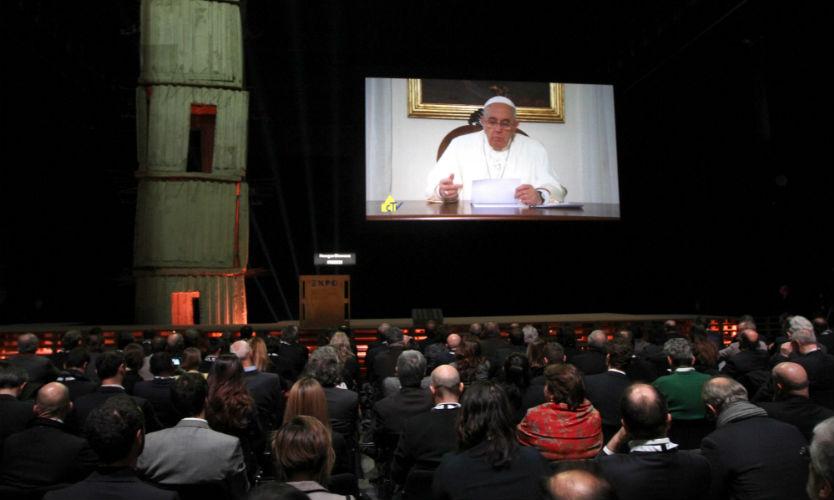
Pope Francis on February 7th urged international political and business representatives, who were in Milan for "Expo delle Idee", to prioritize human dignity. Three ways to do it: by moving beyond emergencies to the real priorities, by being witnesses of charity and by acting as custodians and not masters of our planet. His remarks came in a video message. Here’s the integral text of the Pope’s speech
09 February, 2015
traduzione di Laura Tajoli, Eco dalle Città
Pope Francis on February 7th urged business leaders to prioritize human dignity, and suggested three ways to do this: by moving beyond emergencies to the real priorities, secondly, by being witnesses of charity and thirdly, by acting as custodians and not masters of our planet.
His remarks came in a video message that was broadcast to a gathering of 500 international political and business representatives who were in the Italian city of Milan to discuss the theme: Feeding our planet, Energy for Life. This is the theme chosen for the upcoming International Exhibition Expo 2015 that opens in the northern Italian city in May. Here’s the integral text of the Pope’s speech:
"Good morning to you all, women and men who gathered today to reflect on the issue: Feeding the Planet, Energy for Life.
During my visit at the Food and Agricultural Organization I said that we shouldn’t only consider the crucial factors linked to “production, food availability, climate changes and agricultural trade”, but also that “our firs concern for all of us should be the human person and all those who are suffering hunger and thus stopped to think about life, family, society in order to be able to fight to survive” (FAO Speech, November 24th 2014).
The international community frequently intervenes on nutrition but we assist to what Pope John Paul II used to define as “the paradox of abundance”. “There is enough food for everybody on our planet but not all its inhabitants have access to this food and the waste, the use of it for other means is there before our eyes. That’s the paradox! Unfortunately this paradox continues to be true. There are few other issues like hunger that are so likely to be manipulated by data, statistics, national safety reasons, corruption or by a painful recall of the economic crisis” (ibid). In order to overcome the temptation of sophisms – the nominalization of thought which glides over but never touches the reality – I am suggesting three concrete approaches.
1) Moving beyond emergencies to the priorities
Instead of going for provisional emergency proposals we must act decisively to resolve the structural causes of poverty, remembering that the root of all evils is inequality (cfr Evangelii gaudium, 202). We must say no to an economy based on exclusion and inequality. This economy kills. It’s not possible that when an old man who lives in the streets dies of exposure this is no piece of news whereas a collapse in the stock exchange market becomes a cover story. This is the outcome of the competitiveness law that states that only the strong survive. Beware: this is not just mistreatment but waste as well, in fact “ those who are excluded are not just excluded but also discarded. We therefore need, if we do really want so solve these problems and not lose ourselves in sophisms, to tackle the root causes, inequality. To do this there are urgent choices to make: a rejection of the total autonomy of the markets and of financial speculation.
2) Be witnesses of charity
Politics are so often denigrated but they are an outstanding form of charity because they looks for common good. Charity is the beginning of all micro-relationships: friendly relationships, family, groups, but also of every macro-relationship: social, economical, political. What are the starting points for a healthy economic policy and the principle on which political decisions should be based? The dignity of the human person and the common good. Be courageous in supporting and upholding this principle in the world of politics and of economy to help make the Earth’s treasures more accessible for everybody.
3) Custodians and not masters of the Earth
Like I did before in my FAO speech, I’d like to remember the words of an old farmer: “God always forgives insults and abuses; God always forgives. Men forgive sometimes. The Earth never forgives! We must safeguard our sister Earth, our mother Earth, otherwise her answer will be destruction” (FAO speech, November 24th 2014). In front of the Earth’s goods we must “never forget their origin and their purpose to accomplish an equal and supportive world”, that’s what we find written in the Church social doctrine. We received the Earth so that she could be a mother for us and that she would give us what we need to live. Our planet is a mother for all of us, it asks for respect and not violence, or worse still, the arrogance of masters. We must hand it to our children, cared for and improved, because it’s a loan they make to us. And it’s not just Christians who should adopt this approach for safeguarding our Earth, it’s the responsibility of everyone. Iin order to do that, we need to take care of ourselves and not be afraid of goodness, or rather tenderness. We need to safeguard the Earth not only with goodness but also with tenderness.
These are the three approaches that I’m offering you in order to overcome the temptation of the sophisms, of the nominalizations, of those who try to do something but without life’s concreteness. We need to choose starting with priorities: human dignity, be witness of charity; safeguard the Earth, mother of us all.
I ask you to pray for me: I need it. And may the blessing of God be with you. Thanks."
Leggi anche:
Le regole di Expo tradite all'Hangar Bicocca. L'organizzazione si scusa
Spreco di cibo, cosa si può fare. Le interviste di ECO all'Expo delle Idee | VIDEO
“Formichine salvacibo”, a special "Eco dalle Città" award for the schools engaged in the food waste combat
Eco-friendly cooking water cleans the fat off the dishes