Food for Good: recovery design
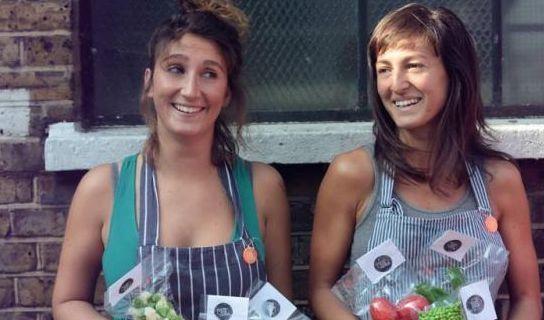
Anna Cennamo and Martina Giulianelli created in London a social enterprise that recovers wasted food.
29 March, 2015
Sunday 1st March I met Anna Cennamo, Neapolitan girl who studied at the London College of Communication. She participated at the Refood, cibo in ricreazione (Food for breaks), an event organized by Qubì Association in oo-operation with Turin Food sharing. Anna talked about how, together with Martina Giulianelli, another Italian in London, structured Food for Good, a social enterprise dedicated to food waste recovery.
The idea to
apply designer know-how to food was conceived in 2011, at the University. At
that time Martina worked for a bakery that used to throw away unsold bread
every evening, and this always made her mad. She then decided to take processed
food, like sandwiches and pizza slices form supermarkets and shops to give it
to charity associations. A simple idea, apparently, based on connecting the
offer of wasted food with the demand coming from poor people who cannot afford
buying food. In this firs phase the University donated a 2000 pounds prize,
just to start the test together with a van and all the necessary material to
print promotional material, etc. Unfortunately Anna and Martina realized that
things weren’t that easy. Charity associations, in fact, prefer to cook food
and then distribute it where needed, whereas processed food has to be given
away very quickly, before deteriorating. Anyway, they didn’t give up.
They decided to find fresh food in the local markets. This one too seemed to be a simple idea, but it was very tiring as well: the recovered food wasn’t enough, they had to negotiate with each pitchman who often didn’t understand why these two girls wanted to take ugly, wasted food. The pitchman would say, most of the times, something like: “take this nice food, buy this, don’t buy the other ugly one”. Another obstacle, but the girls are tenacious and go on. They went directly to the source, to the wholesalers that distribute fresh food in London. Two of them open their stores where Anna and Martina can find fresh food in a good state which doesn’t’ look so good because it has an irregular shape or because it’s just a little bit bruised. Here they clearly understand that the food which is thrown away is still good, it’s just food that has been all over and then put back into the store with no place to go to. That is why 40% of the western food is wasted. What can they do with abandoned food? At the beginning they vacuum-seal it and try to distribute it to in small shops but this doesn’t work because vacuum sealing doesn’t communicate the idea of sustainability. Anna and Martina, then in 2013, try to create a sustainable catering. This time the plan works. Their clients are above all social enterprises or companies that want to communicate their attention towards the environment and female enterprises. The University itself uses the catering for congresses and events.
Anna and Martina pay much attention to communication. They understood that as you recover food you need to communicate beauty and coherence as well as sustainability. Anna explained that this is often a problem for those who work in this field “People believe that it’s sufficient to do well just one thing, but if this is related to waste you have to evoke concepts that are far from the dump”. That’s why they used the vacuum-sealing idea to preserve day by day what they collect and make it beautiful to see as well. “Less waste more taste” is one of the slogans they invented. They have also created a range of products: tablecloths, posters, napkins from recycled fabrics and paper. They make the posters using old ones and vegetable fibres like almond shells, so that their message is totally clear. Furthermore, they always have a dialogue with the people that enjoy their catering, they present their products, the chefs that have cooked, they sell jams to make sure that people can intervene and ask questions if they want to. Clients that are interviewed during the catering become testimonials of the videos of their site http://www.foodforgood.me/.
Food for Good is now part of the network http://feedbackglobal.org born around Tristam Stuart, author of Uncovering the Global Food Scandal. Thanks to Stuart’s celebrity it0s possible to negotiate loans, to bring about projects centred on the many food wastes reduction throughout all the different phases: production, stoking, distribution and selling. If we consider that the waste is not only related to food but also to the work that it has required, to water and fertilizers, packaging, transports and more, we may then realize that this is a huge problem.
Anna and Martina started from the food waste problem to find the missing connections: the first one is between suppliers and those poor people that cannot have a proper access to the market; the second is between waste, beauty, food, relationships, conviviality issues. For this reason their caterings are well-finished and prepared by top chefs that make you forget anything related to dumps. They have a designer mind and they designed a complex process where action and communication are deeply linked. The only difference with the traditional industrial design is that their projects start from the limits: “Do we have nothing but artichokes?”, said Anna, “Well, in that case we will have to think about four different ways to cook them. We are finding solutions”. Accomplish objects and dishes moving from the limits, that’s what they do.
One of the problems they are facing right now is the vacuum-sealing plastic. They looked for a company that used recycled plastic, but they couldn’t find one. To make up for it they have presented a new range of tablecloths and napkins coloured with dyes extracted from fruit and vegetables remains. Anna and Martina still don’t make up a living from this activity. Martina works in a bar where she prepares vegetable soups using vegetable food waste. In 2014 with Anna they recovered